


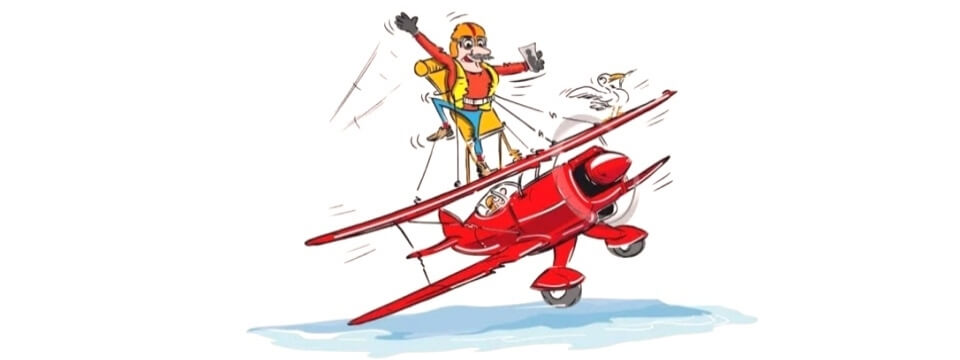
Helga Duffy, at 99 years old, has set a record as the world’s oldest wing walker.
Inspired by 97-year-old Betty Bromage’s wing walking debut on the news, Helga decided to take on the challenge herself.
Although she now lives in a care home in Devizes, Wiltshire, Helga spent many years in Frome, Somerset. Reflecting on her experience strapped to a small plane, she remarked, “I wasn’t frightened because I was so excited.”
She completed her aerial adventure at RFC Rendcomb Airfield in Cirencester, Gloucestershire, raising funds for the Wiltshire and Bath Air Ambulance in the process.
As the eldest of seven children, Helga expressed pride in making her father proud. “He expected the best of us. So I always tried. I think if he’s up there somewhere, he’d be very proud of his firstborn,” she said. Officials from Guinness World Records presented her with a certificate at the airfield.
Nieces Jackie Rose and Julie Preece, who cheered her on during the flight, described Helga as an “independent” and “forthright lady.” Jackie shared, “She’s wanted to do something different for so long.
She just wanted to prove that even at 99, she’s still that lady she was years ago.” The flight was especially touching for them, as their mother made her “final journey” in an air ambulance.
Sam Conway from the air ambulance charity called Helga a “legend,” celebrating her achievement of raising over £1,300. “She looks as though she’s had the time of her life,” Sam added.
Betty, whose record Helga surpassed, extended her congratulations playfully, saying, “I can’t wait until I’m 100 so I can do it again and beat you.” Having completed six wing walks herself, Betty admitted, “I really enjoy doing it – it’s a bit frightening at first, isn’t it? Just the apprehension of it.”
What is Wing Walking?
Wing walking is an extreme aviation activity where individuals stand, move, or perform acrobatics on the wings of a flying airplane, typically a vintage biplane like a Boeing Stearman.
The practice began in the 1920s during post-WWI “barnstorming” aerial circus shows in the U.S., where pilots showcased mid-air stunts to captivate audiences.
In modern wing walking, participants secure themselves with a specialized overhead rig and a five-point harness attached to the top wing of a biplane.
Flights usually last about 8 to 10 minutes, reaching speeds between 80 to 140 mph and altitudes up to 1,000 feet. Participants may experience high wind forces, G-forces of up to 4G during maneuvers, and fleeting moments of zero gravity.
Unlike the early stunts of the 1920s, which often lacked safety measures, today’s commercial wing walking adheres to strict safety protocols, including detailed briefings, heavy-duty metal support frames, and redundant harness systems.
On the ground, a “wing walker” can also refer to a crew member who walks alongside an aircraft on the tarmac, guiding the pilot to prevent collisions with obstacles or buildings.
Content contributed and edited by Andy Howard, Cirencester and Sophie Parker, Wiltshire, reported from Cirencester, Gloucestershire, England, UK, sourced by bbc.com/news/articles