


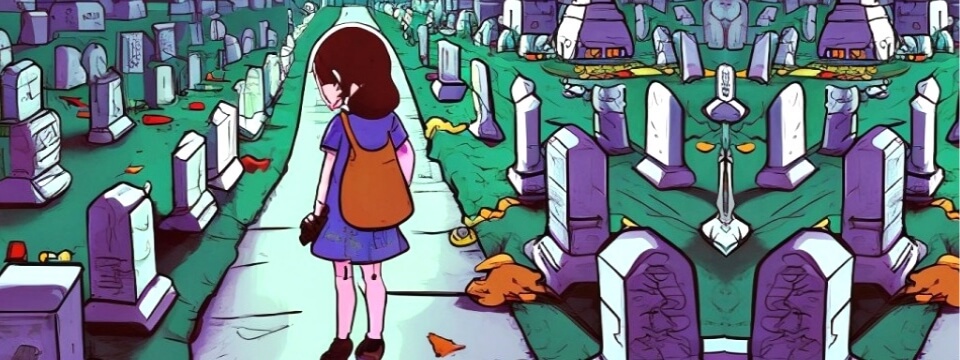
During Halloween season, many neighborhoods showcase front yards adorned with fake tombstones and ghosts.
While some refer to this decor as “graveyard” decorations, others prefer “cemetery.” People often use the terms “graveyard” and “cemetery” interchangeably, but there’s a key distinction between the two.
What is a Graveyard?
A graveyard is an area of land, typically adjacent to a church, where people are buried. During the Middle Ages, influential Christians were often interred inside churches, usually in crypts beneath the floors.
In contrast, less affluent congregants were buried outside in church yards, which later became known as graveyards. This practice persisted for centuries.
The term “graveyard” originates from the proto-Germanic words “graban,” meaning “to dig,” and “gardan,” referring to an enclosed area.
What is a Cemetery?
A cemetery, like a graveyard, is a place for burying the dead, but it emerged as a modern concept. By the early 19th century, rapid population growth filled church graveyards, leading to the establishment of independent burial grounds known as cemeteries.
Unlike graveyards, cemeteries are not affiliated with specific churches, allowing anyone, regardless of their religious background, to be buried there. They are often located outside of city or town centers to accommodate more space.
The word “cemetery” comes from the Greek “koimeterion,” which means “dormitory” or “resting place.” Early Christians adopted this term to describe a deceased person’s final resting place.
What’s the Difference?
While it’s acceptable to use “graveyard” and “cemetery” interchangeably today, “graveyard” specifically refers to burial areas associated with churches.
For linguistic precision, use “graveyard” for church grounds and “cemetery” for independent burial sites. Some cemeteries may have religious affiliations, but they typically aren’t tied to a specific place of worship.
Visually, graveyards often evoke images of old churchyards in the English countryside, featuring older tombstones arranged in a somewhat haphazard manner. These sites are smaller and may not be meticulously maintained.
On the other hand
In contrast, cemeteries are generally larger, more modern, and better maintained, with neatly organized rows of plots. You’ll often find larger, contemporary family plots in cemeteries.
Regardless of the term you choose, it’s essential to show respect when visiting a cemetery or graveyard. Save the Halloween antics for decorations, not for actual burial sites.