


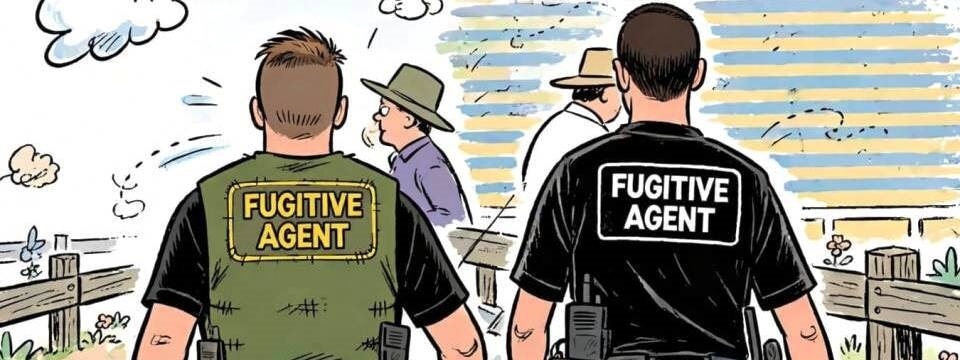
Bounty hunters, also called fugitive recovery agents or bail-enforcement agents, operate as private contractors rather than serving as sworn law enforcement officers.
A bail bondsman hires these agents to track down and capture defendants who skip bail and miss their court appearances.
The primary duty of a bounty hunter involves researching, tracking, apprehending, and returning fugitives to the appropriate government agency. To successfully capture criminals, bounty hunters must:
– Communicate effectively with a wide range of individuals, from fugitives to law enforcement officials.
– Conduct thorough surveillance.
– Investigate and gather compelling evidence.
Bounty hunters typically earn a commission of about 10% to 15% of the total bail amount for successfully returning fugitives to custody and employ methods such as surveillance, background checks, skip tracing, and monitoring social media or associates to locate fugitives.
The legality and regulations surrounding bounty hunters vary significantly by location. While they primarily operate in the United States, they face prohibition in states like Illinois and Kentucky and require specific training or licensing in places such as California, Texas, and Nevada.
Although modern bounty hunters, like the Big Rig Bounty Hunters, face challenges, the history of bounty hunting features many talented, tough, and sometimes morally questionable agents.
Keep on reading about the five famous bounty hunters of their time.
John of the Priests
In 1709, the Penal Act compelled all Catholic priests to take the Oath of Abjuration, recognizing the Protestant Queen as the Supreme Head of the Church of England and Ireland. Clerics who refused faced a death sentence.
John Mullowney, arrested as a horse thief in Castlebar, Ireland, faced a choice: hang or become a Priest Hunter. He chose the latter and quickly became a “talented rogue,” excelling at capturing clergy for up to £100 for an Archbishop or Bishop.
Mullowney often feigned a deathbed confession before revealing a concealed weapon to ensnare his targets. He met his end when a local Catholic fatally stabbed him while he attempted to kill the last remaining priest in his parish.
Locals disposed of his body in a lake, and after retrieval, they buried him in unconsecrated ground nearby. Legend has it that a tree near his grave has grown but never bloomed since.
Thomas Tate Tobin
In 1863, three Mexican National cousins known as the Espinosas embarked on a killing spree, murdering over thirty English-Americans in the San Luis Valley, Colorado, as revenge for relatives killed in the Mexican-American War.
When authorities failed to capture the men—Wanted: Dead or Alive—they called in renowned adventurer Tom Tobin. Even though they assigned him fifteen men, Tobin chose to go out alone.
Upon his return, someone asked about his trip, and he reportedly replied “So-so” before tossing down a sack that contained the severed heads of all three Espinosas.
Patrick Floyd “Pat” Garrett
In November 1880, Lincoln County, New Mexico, appointed Pat Garrett as sheriff, a man known for his marksmanship. Garrett’s task was to track down an old acquaintance from his bar-keeping days: twenty-one-year-old Henry McCarty, who had escaped from prison and reportedly killed as many men as years he had lived.
Known today as Billy the Kid, he attracted a $500 reward for his capture from New Mexico Governor Lew Wallace. After a bloody pursuit that saw many members of the Kid’s gang killed or arrested, Garrett finally ambushed and killed the outlaw with a single blast from his Sharps rifle.
However, Garrett never received the reward because it applied only to Billy’s capture, not his death. To this day, some believe that Billy the Kid survived that night and that Garrett staged the whole event to allow his old friend to disappear.
Ralph “Papa” Thorson
Ralph “Papa” Thorson reportedly apprehended over twelve thousand fugitives, with his life inspiring Steve McQueen’s final film, “The Hunter” (1980). Sometimes, Thorson adopted an eccentric approach, utilizing astrological charts to locate criminals.
He also preferred using non-lethal force, such as his invention, the “Prowler Fowler,” which fired beanbag rounds at assailants. In 1994, a car bomb—likely planted by one of the many enemies he made during his career—killed him.
Domino Harvey
Born in 1969 to actor Laurence Harvey and fashion model Paulene Stone, Domino Harvey embraced her identity as a tomboy, showing a keen interest in martial arts and action figures, interests seldom shared by her peers at exclusive English boarding schools.
After attending four schools and getting expelled for her “unladylike” behavior, she initially pursued modeling but later moved to the USA. In 1993, after an unsuccessful application to the Los Angeles Fire Department, she enrolled in a short course to become a bail recovery agent.
Domino primarily targeted drug dealers and thieves, tracking murderers as well. She excelled in her role, earning up to $40,000 annually. Tragically, she succumbed to drug addiction and died from an overdose in 2005.