


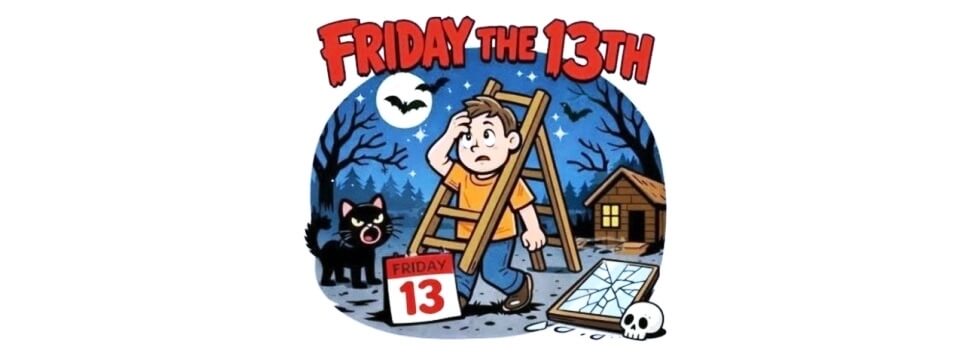
Unraveling the Fear of Friday the 13th: Origins, Dark History, and Future Dates.
Have you ever noticed how people get extra jumpy on Friday the 13th? There’s a clear reason behind that heightened anxiety. From medieval execution Fridays to party-crashing Nordic gods and a cult horror franchise amplifying the fear, Friday the 13th carries a heavy reputation.
Is this day merely a superstition, or do people truly misunderstand it? Let’s dive into the origins of Friday the 13th, reflect on historical events that reinforced its unlucky status, and explore why it continues to captivate us.
The Origins of Friday the 13th
Both Friday and the number 13 carried significant negative associations long before they joined forces as a superstition. The number 13, like many numerical superstitions, has roots in Norse mythology. According to legend, Loki, the god of mischief and trickery, crashed a divine banquet in Valhalla as the 13th guest, leading to chaos and death.
In Christianity, the number 13 also comes with a dark history. Judas Iscariot, the 13th guest at the Last Supper, betrayed Jesus, forever linking the number to treachery.
Fridays bore their own burden of ill fortune, too. In medieval Europe, people served them as execution days, with Good Friday being particularly infamous due to its association with Jesus’s crucifixion. Traditional Catholics reinforced this negative image, believing Friday to be a day of penance.
Together, Friday and the number 13 formed an unwanted duo on the calendar, resulting in Friday the 13th becoming synonymous with bad luck. This superstition has not only persisted but also evolved and spread worldwide.
Dark Historical Events on Friday the 13th
While the origins of Friday the 13th stem from mythology and religion, real-life events have further cemented its ominous reputation:
– The Knights Templar Massacre (1307): King Philip IV of France sought to erase his massive debt to the Knights Templar by ordering their mass arrest. On Friday, October 13, hundreds faced torture and execution, marking a day forever in history.
– The Andes Flight Disaster (1972): On October 13, Uruguayan Air Force Flight 571 crashed in the Andes, claiming the lives of 29 passengers and crew. The 16 survivors endured over 70 days of freezing temperatures before rescue.
– The Bombing of Buckingham Palace (1940): During the London Blitz, a direct hit on Buckingham Palace narrowly missed King George VI and Queen Elizabeth, proving that even the royal family couldn’t escape the day’s curse.
The Ongoing Fear of Friday the 13th
The fear of Friday the 13th, known as “paraskevidekatriaphobia,” affects millions worldwide. Many choose to avoid significant decisions, travel, or medical procedures on this day, causing measurable economic impacts, particularly for airlines and hotels.
Hollywood has played a crucial role in fueling this fear, with cult horror films like Friday the 13th solidifying the day as a cultural symbol of dread. Jason Voorhees’s hockey mask has become a staple Halloween costume, and the franchise continues to expand.
The Psychology Behind Superstitions
Why do we hold onto this fear surrounding Friday the 13th? Psychologists suggest that superstitions help us feel in control. When something goes wrong on this seemingly cursed day, it’s often easier to attribute it to bad luck rather than random chance.
Upcoming Friday the 13ths
Every year features at least one Friday the 13th, with some years including up to three. In 2025, the only Friday the 13th falls in June. However, 2026 will see the maximum of three: February 13, March 13, and November 13. In 2027, only one Friday the 13th occurs, landing on August 13.
Whether you choose to stay inside, laugh off the day’s superstitions, or intentionally walk under a ladder, Friday the 13th has proven its enduring power as a cultural superstition.