


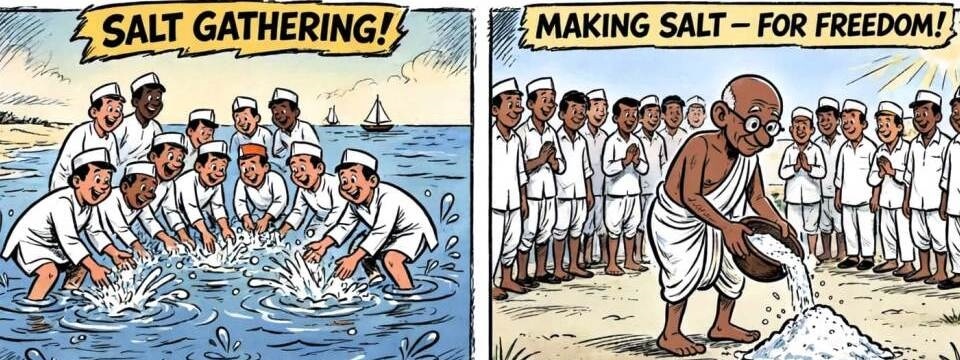
Gandhi’s Salt March, also known as the Dandi March, took place in 1930 and was a heartwarming chapter in India’s journey toward independence.
Led by the inspiring Mahatma Gandhi, he and his followers walked about 240 miles from Sabarmati Ashram to the coastal village of Dandi.
Their goal was to peacefully protest the British salt monopoly, which unfairly taxed salt and prevented Indians from making their own. By marching to the sea to create salt, Gandhi encouraged a spirit of civil disobedience and nonviolent resistance.
This remarkable journey brought together people from all walks of life, uniting them in the fight for freedom and capturing the world’s attention.
On March 12, 1930, Mahatma Gandhi embarked on a remarkable journey. By this time, he had become a passionate advocate for India’s independence from British rule and had successfully led several movements of civil disobedience. Yet, even some of his closest supporters found his latest plan a bit puzzling.
An anti-colonialist movement led by Gandhi
Gandhi envisioned a march centered around salt. At that time, the British Empire had a tight grip on salt production in India, imposing hefty taxes and making it illegal for Indians to produce salt themselves.
For Gandhi, this issue beautifully captured the oppressive nature of colonialism.
He expressed, “Next to air and water, salt is perhaps the greatest necessity of life,” believing that a mass protest against the salt laws could breathe new life into the Indian independence movement.
Satyagraha
Many activists thought his idea was a little underwhelming, arguing that reforming salt laws didn’t have the inspiring flair needed for a national struggle.
Jawaharlal Nehru, who would later become Prime Minister of India, remembered their confusion: “We could not fit a national struggle with common salt.”
An article from an Indian newspaper even suggested that most educated people would find the idea amusing. But for Gandhi, this issue mattered deeply. He saw it as a call for nonviolent resistance, which he named “satyagraha” or “truth force.”
He viewed the planned salt march as a serious campaign, declaring, “We are entering upon a life and death struggle, a holy war.” Meanwhile, British officials remained unimpressed, with the Viceroy of India saying that the thought of a salt campaign didn’t keep him up at night.
Civil disobedience and nonviolent resistance
On that historic day, Gandhi and a small group of followers set out from his ashram in Ahmedabad, aiming for the coastal town of Dandi, over 240 miles away.
They planned to walk about 12 miles a day, and the 61-year-old Gandhi quickly became an inspiring figure in his simple white robes and walking stick.
As they walked from village to village, more and more supporters joined them each night. Journalists and filmmakers captured the excitement, and thousands gathered to hear Gandhi speak passionately against the salt laws.
Gandhi’s Salt March
Gandhi framed the march as not only a fight for national independence but also for class equality, bringing together the oppressed people of India. He understood how vital it was to include the poor in the independence movement.
Villagers came not just to listen, but to march alongside him, filled with hope from his powerful message of “right against might” and the spectacle of a sea of people stretching for miles.
The pivotal moment arrived when they finally reached Dandi. Gandhi boldly broke the salt laws by evaporating sea water to make his own salt. Holding up a handful of salty mud, he joyfully declared, “With this, I am shaking the foundations of the British Empire.”
The success of the march ignited a wave of civil disobedience across the country, with millions following Gandhi’s lead by defying the salt laws.
It’s estimated that around 60,000 people were arrested, and Gandhi himself found himself in custody while preparing to lead a nonviolent raid on the Dharasana Salt Works in Gujarat.
The raid continued without him, with protestors committed to Gandhi’s principles of nonviolence, even as they faced police brutality.
Journalist Webb Miller wrote, “Not one of the marchers even raised an arm to fend off the blows. They went down like ten-pins. From where I stood, I heard the sickening whacks of the clubs on unprotected skulls.”
Winston Churchill on Gandhi
Despite the violence and mass arrests, Gandhi’s salt protest captured the world’s attention. Time magazine recognized him as its Man of the Year, and American journalists likened Indian defiance to the Boston Tea Party.
The British government couldn’t ignore the impact, leading to a 1931 meeting between Gandhi and the Viceroy of India. This resulted in a pact that released political prisoners and allowed Indians to produce salt in coastal areas.
Although this agreement didn’t fully meet the hopes of Gandhi’s allies and frustrated many in the British establishment—including Winston Churchill, who criticized Gandhi as a “seditious fakir”—the influence of the salt march was profound.
As Nehru beautifully said, “Non-cooperation dragged them out of the mire and gave them self-respect and self-reliance.” This iconic march helped solidify Gandhi’s legacy as one of the most inspiring thinkers and activists of the 20th century, lighting a path toward independence for an entire nation.
Taking on the might of the British Empire to secure independence for India, Mahatma Gandhi became one of the most recognizable figures in the world and an enduring role model for Martin Luther King Jr. and other civil rights heroes.
While this is common knowledge, here are some intriguing facts about one of the 20th century’s true political giants.
His Name Wasn’t Mahatma
Gandhi’s first name was Mohandas. “Mahatma,” meaning “great soul,” is a title that denotes love and respect. A friend, Pranjivan Mehta, first referred to Gandhi as “Mahatma” in writing in a letter from 1909, years before he became a global icon.
He Got Married at Thirteen
In 1883, thirteen-year-old Gandhi married fourteen-year-old Kasturbai Kapadia in an arranged union. Gandhi later noted that, for them, marriage meant simply wearing new clothes, eating sweets, and playing with relatives. He became a father at sixteen, though his first child lived just a few days. The couple later had four more children who survived to adulthood.
He Was in London During the Jack the Ripper Incident
While studying law in London, Gandhi became a dapper gentleman of Victorian society. He arrived in September 1888, amid the Jack the Ripper killings, eager to mingle and make friends. Alongside taking dancing lessons, he joined the Vegetarian Society, where he served on the executive committee with Arnold Hills, the future founder of West Ham United football club.
He Suffered from Stage Fright
Meek and shy by nature, Gandhi experienced significant stage fright during a debate at the London Vegetarian Society, leading someone else to read his arguments. This fear hindered his early career as a barrister. On his first attempt to cross-examine a witness, nerves overwhelmed him, causing him to retreat into his chair and abandon the case.
He Became a Civil Rights Activist in South Africa
Although synonymous with the Indian independence struggle, Gandhi first emerged as a civil rights crusader in South Africa. Arriving in 1893 to work as a law clerk, he faced stark racism, including being ejected from a first-class train despite holding a ticket. This ignited his determination to combat “the deep disease of colour prejudice.”
He Helped the British Empire
Despite disillusionment with colonial racism, Gandhi felt a sense of duty towards the British Empire. During the Boer War (1899-1902), he formed the Natal Indian Ambulance Corps, rallying hundreds of volunteers to assist wounded British soldiers. “If I demanded rights as a British citizen, I felt it was also my duty to defend the British Empire,” Gandhi explained.
He Carefully Cultivated His Image
Gandhi didn’t wear his iconic white loincloth and shawl merely as a nod to tradition; it was a strategic political statement he adopted on September 22, 1921. This move encouraged Indians to boycott foreign-made clothes in favor of khadi, hand-spun fabric, dramatically reshaping his public image.
He Was Friends with Tolstoy
Gandhi shared a significant friendship with Russian novelist Leo Tolstoy, the author of *War and Peace*. Tolstoy’s writings on non-violent resistance inspired Gandhi deeply. In 1909, he wrote to Tolstoy seeking guidance, leading to a fruitful exchange of letters about non-violence, with Tolstoy’s final letter to Gandhi being among his last written works.
He Returned to London and Stayed in the East End
In 1931, Gandhi revisited London for three months of talks about constitutional reforms in India. While the government offered him a luxurious West End hotel, he chose to stay in a community center in Bromley-by-Bow. He enjoyed long walks in the East End, mingling with locals, hosting notable visitors like Charlie Chaplin, and relishing the quick wit of Cockney humor.
He Never Won the Nobel Peace Prize
Gandhi first appeared on the Nobel Peace Prize shortlist in 1937, but skepticism about his Indian nationalist beliefs, which some claimed incited violence, led to his rejection. He faced the same outcome in 1947, just before his assassination the following year. Notably, no Nobel Peace Prize was awarded in 1948.
He Was Shot by a Fellow Hindu
Gandhi met his assassination during India’s turbulent Partition. A fellow Hindu, Nathuram Godse, who believed Gandhi was too lenient toward Pakistan, fatally shot him on January 30, 1948, after several earlier attempts.