


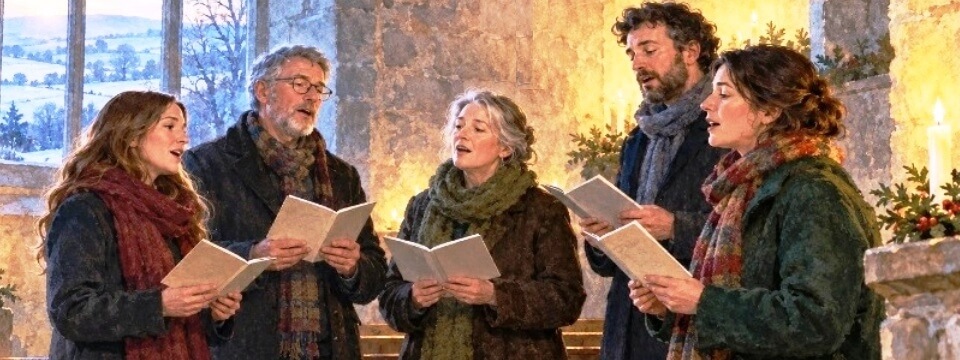
Various traditions gave rise to Christmas carols, starting from the 4th century and earlier when early Christians sang hymns to celebrate Jesus’ birth.
Many ancient pagan songs honoring the winter solstice and the sun’s return began as carols. As Christianity spread, people transformed these festive songs into hymns celebrating the Nativity. In the Middle Ages, communities sang them during church services and gatherings.
By the 15th century, carols included secular themes, focusing on joy and festive gatherings, often performed in markets. The 19th century brought well-known carols like “Silent Night,” blending sacred lyrics with traditional melodies.
Different cultures create unique carols that reflect local traditions, enriching the global holiday music tapestry. Christmas carols have existed for centuries, but we must go back to ancient times to find their origin.
Saturnalia
During Saturnalia, devotees worshiped Saturn around the winter solstice in hopes of an abundant harvest.
Many have cited the Roman tradition of Saturnalia as a pre-Christian version of Christmas which was similarly full of merriment and, crucially, song.
But songs have hard-wired into our genetic makeup and form a part of our oral history passed down through the generations. However, it’s likely that people have always sung devotional songs, especially on the shortest, darkest days of the year.
So, it’s unlikely that Saturnalia kick-started the tradition of the Christmas carol, especially when we consider that most carols come from the 1800s.
Wassailing
Anglo-Saxons predominantly remained illiterate, so any evidence of wassailing (the act of singing songs in and around the winter solstice) survives through tradition and archaeological objects.
The Vikings may have brought wassailing to these shores shortly after the Romans vacated, as the word is thought to derive from the Norse word ‘ves hail’, meaning ‘be well’. And, although some variations exist on the practice, the wassailing tradition appears to have its roots in apple orchards, where people heartily toasted the fruit trees with drink and song to ward off evil spirits in the cold winter months to ensure an abundant crop later in the year.
In time, the wassailing revelers would leave the orchard and, armed with a large bowl filled to the brim with a potent punch, visit friends and neighbors to join them for a drink and a few convivial choruses of seasonal songs, just like today’s carol singers.
But not all wassailing remained good-spirited. Some wassailers gathered outside the larger, better-off dwellings and essentially threatened the owners with mischief unless they provided something in return. And if this sounds like trick or treating, some historians have suggested that wassailing may even lie at its source, but that’s another story.
We Wish You a Merry Christmas?
This murky side of wassailing may even provide a link to one of our most popular carols. If we look a little more closely at the lyrics to We Wish You a Merry Christmas, something rather sinister appears to be going on.
The chorus begins with the seemingly innocuous, ‘good tidings we bring, to you and your kin’, before demanding, ‘…now bring us some figgy pudding’. The second chorus ends with a reminder that this is a group endeavour (‘for we all like our figgy pudding’) before a barely concealed threat completes the third chorus, ‘And we won’t go until we get some, so bring some out here’.
Little wonder then that many parishes banned wassailing during the medieval period but, if you’re lucky enough, you can still catch the odd wassailer in one of the cider-producing regions of the UK and maybe in one of the most popular carols sung at Christmas…
Deck the Halls
The English version of this ditty didn’t get published until 1862. It included the lines, ‘see the flowing bowl before us,’ and ‘laughing quaffing all together,’ which could easily refer to both the wassail and the wassailers respectively.
In addition to the opening lines, mindful of the ancient habit of decorating one’s property with evergreens during midwinter, it almost goes out of its way to not acknowledge Christmas, referring to it instead as ‘Yuletide’.
Christmas number ones
We can also see our former Christmas number one singles as an extension of the pre-Christian tradition of communal singing in the dark autumn/winter months.
Many of these Christmas number ones, and more than a few almost-rans, have served as soundtracks to our Christmases, even if the artists in question faded into obscurity. They are, in many respects, the contemporary version of the Christmas carol and, likewise, employ both secular and religious themes.
A song for the festive season
Carol singers at Christmas form as much part of the celebrations as baubles, tinsel, and granddad falling asleep in front of the television. Sure, Christmas as we know it may well have come from non-Christian traditions, but that misses the point.
Christmas represents a time of coming together to celebrate both the end and the beginning of the year during the darkest, coldest days of the calendar. And there’s no better way to honor the occasion than with loved ones, a raised glass, and belting out a preferred festive song.
Finally, the definition of ‘carol‘ refers to a ‘joyful song’, which derives from ‘carole’, an old French word meaning to dance in a ring, which might even imply that much more existed in the original notion of a carol than just singing. But what exactly lies somewhere in the distant past.