


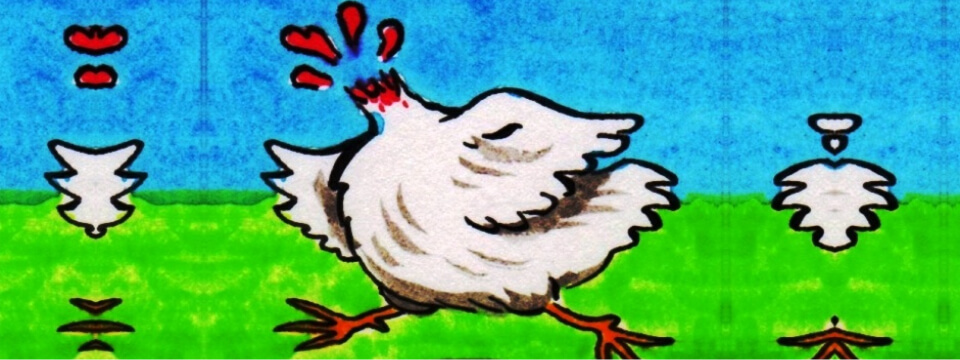
Chickens sometimes exhibit surprising behavior after farmers decapitate them, continuing to run around for a short while—often up to 15 minutes.
However, one remarkable bird named ‘Mike the Headless Chicken’ defied all odds by walking for an astonishing 18 months after losing his head, capturing the imagination of many and securing his place in history.
Mike’s Origins
Mike’s extraordinary journey began on a small farm in Fruita, Colorado, in September 1945, shortly after the conclusion of World War II.
A farming family, the Olsens, prepared a batch of 40-50 chickens for the market, intending to earn a living after the war.
Lloyd Olsen, the head of the family, and his wife, Clara, worked together diligently—Lloyd decapitated the birds while Clara plucked and cleaned them, ensuring that as many as possible were prepared for sale.
As they processed the chickens, they paid little attention to the individual birds, focusing instead on their work. However, at the end of the day, the couple noticed something peculiar happening with one of the roosters.
Despite its decapitation, this particular rooster continued to move, walking around as if nothing had happened.
Curiosity struck the Olsens; they were both bewildered and intrigued. A chicken’s spinal cord can maintain its ability to send reflexive messages through the nervous system for a brief period following decapitation, leading to involuntary movements that can make the chicken’s legs appear to be running.
Yet Mike, a Wyandotte, continued to demonstrate incredible vitality hours after the fatal act, leaving the Olsens completely perplexed. Deciding to investigate further, they moved Mike to their porch and gently placed him in a box to keep him safe.
Fame and Fortune
The following morning, the Olsens were astonished when they found Mike still alive and moving, despite the severe injury he sustained.
The couple decided to care for the bird, wanting to see how long he could survive without his head, a phenomenon that intrigued both scientists and casual observers alike.
They took Mike with them when they went to sell the rest of the chicken carcasses at the local market. For a bit of amusement, Lloyd started betting bystanders that he had a living headless chicken in his wagon.
Word quickly spread about Mike, and soon enough, local press outlets began to show interest in the miraculous creature.
Within a couple of weeks, a sideshow promoter named Hope Wade traveled hundreds of miles from Utah just to visit the Olsen farm.
Enchanted by Mike’s story, Hope convinced the Olsens that they could capitalize on Mike’s unusual condition and earn a decent income by displaying him across the country.
The idea of making a profit was particularly enticing for the struggling farmers, and they eagerly agreed to embark on the road trip with Mike, envisioning a brighter future.
A Marvel Explained by Science
Before unveiling Mike to the masses, the Olsens took him to the University of Utah in Salt Lake City. There, scientists conducted examinations to understand how Mike had managed to survive against all odds.
They explained that the majority of a chicken’s brain resides in the back of its skull, situated behind the eyes. Even though Lloyd had removed much of Mike’s head—including his beak, eyes, and one ear—most of the brain remained intact, continuing to control essential bodily functions, such as breathing and digestion.
Furthermore, a fortunate blood clot had formed, preventing Mike from bleeding to death immediately after the decapitation.
As the scientists described Mike’s anatomy, they noted that he was an incredibly lucky chicken, defying the expectations of what should have happened.
However, it was also clear that Mike required significant care to continue living this strange existence.
The Olsens became devoted caregivers, utilizing a dropper to feed him and administer water directly into his esophagus while using a syringe to clear mucus from his throat.
A National Tour for Mike
As Mike’s fame grew, his story hit national headlines. Life Magazine sent a journalist and photographer to cover the phenomenon, further solidifying his status as a media sensation.
The Olsens, now working closely with Hope Wade, took Mike on a whirlwind tour across California, Arizona, and the southeastern USA.
During their travels, they made several stops back at home on the family farm, which allowed them to catch up on the overwhelming amount of fan mail that poured in from across the country.
While many letters applauded the Olsens for their unusual pet, others criticized their decision to capitalize on Mike’s condition, prompting debates about the ethics of keeping a headless chicken alive for entertainment.
A Tragic Accident
The remarkable saga took a heartbreaking turn while the Olsens were touring in Phoenix, Arizona, in the spring of 1947. One fateful night in a motel room, an accident led to Mike’s premature demise.
The Olsens were awakened by the sound of Mike choking on mucus, a common issue he faced due to his unique conditions.
In a panic, they frantically searched for the syringe they had left behind at their previous sideshow. Without an alternative means to clear Mike’s throat, the situation quickly turned dire. Tragically, Mike suffocated to death that night.
Overwhelmed with embarrassment at accidentally killing their prized attraction—the ‘goose that laid the golden egg’—Lloyd immediately reacted by covering up the incident.
He told people he had sold Mike to another promoter, attempting to deflect attention from the truth.
For decades, the real circumstances surrounding Mike’s demise remained a closely guarded secret until Lloyd finally admitted the truth to his great-grandson, Troy Waters.
Troy speculated that after Mike’s death, he was likely discarded in the desert, potentially becoming a meal for coyotes.
In Memory of Mike
In the wake of Mike’s unusual life and tragic end, the Olsens experienced a drastic change in their fortune. Thanks to the attention and income generated by Mike’s strange story, they were able to modernize their farming equipment and buy a new pickup truck, enabling them to enhance their agricultural practices.
The Olsens continued to spend their days farming the land, often reminiscing about their unique journey on the road with the astonishing bird who had brightened their lives.
Today, Mike remains the only known chicken to have survived for such an extended period without a head. Various attempts to recreate Mike’s phenomenon, including efforts made by a neighbor of the Olsens, have met with failure, affirming the singularity of Mike’s case.
His legacy continues to thrive in Fruita, celebrated annually at the ‘Mike the Headless Chicken Festival.’ This lively event features a 5K run, music, an array of food stalls, games, and ample opportunities for festival-goers to don headless chicken costumes and enjoy themed merchandise, ensuring that Mike’s remarkable life and the fascination it inspired live on in collective memory.