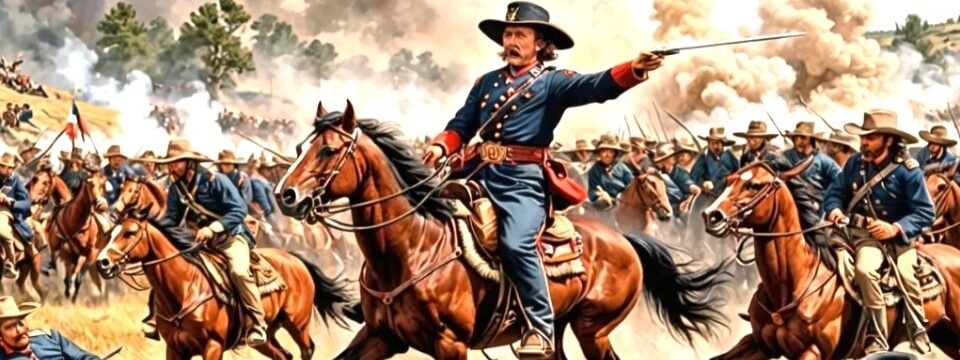
As of now, no one has found Custer’s lost treasure.
This legendary treasure, estimated at around $25,000 in cash, gold, and silver, supposedly accompanied Custer’s Seventh Cavalry before the Battle of Little Bighorn in 1876.
An intriguing story connects this treasure to a Cheyenne leader named Two Moons, who allegedly left a sealed envelope detailing the treasure’s location.
Journalist Kathryn Wright supposedly discovered this envelope in a vault at Two Moons’ monument during the late 1950s, but someone stole it before anyone could reveal its contents. Since then, no one has located a verified treasure cache.
While archaeological excavations at the battlefield have confirmed the presence of currency and personal belongings, they have not uncovered evidence of a deliberately buried treasure. Consequently, the existence and location of Custer’s lost treasure remain a mystery as of now.
Custer’s Last Stand
In June 1876, cavalry commander George Armstrong Custer faced a coalition of Native American tribes during the Battle of Little Bighorn, sparked by bitter territorial disputes. Custer and hundreds of his soldiers perished in this bloody episode, which became romanticized in American folklore as “Custer’s Last Stand.”
Beyond the battle itself, the tale led to the mystery of Custer’s Lost Treasure, igniting curiosity about a hidden cache of riches buried in the wilderness.
Does this treasure truly exist, or is it a mere fantasy?
Treasure seekers point to compelling eyewitness testimonies from the time. Legend states that Custer and his men rode into battle with about $25,000 in back pay—an impressive sum then. After their deaths, Native American warriors reportedly took this money and buried it in a secret location.
Surviving soldiers’ accounts confirm the substantial payday. Sergeant John M. Ryan mentioned that, just over a month before Little Bighorn, “the paymaster joined us under an escort of infantry and enlivened the boys’ hearts with about four months’ pay.”
Charles Windolph added in his book, ‘I Fought With Custer’, that “about half of that payroll found its way into the hands of the squaws and Sioux children when the dead troopers were stripped and mutilated.”
Daniel Kanipe described the battlefield’s grim reality: “In all this pile of men, not a one had a stitch of clothes on. The Indians had taken it all. They must have gotten about $25,000 in money off of them, too, for we had just been paid.”
Chief Two Moons
Curiously, Kathryn Wright, a journalist and the first serious treasure hunter, claimed that “not all of it was currency.” She found that soldiers carried gold, silver, and U.S. treasury or bank notes based on army regulations.
Wright’s investigation led her to WP Moncure, a trader with strong ties to the Cheyenne tribe. Moncure had befriended Chief Two Moons, who fought at Custer’s Last Stand.
After Two Moons’ death, a monument erected in his honor concealed a vault. Kathryn discovered it, holding “a portrait of Two Moons, stone tools, arrowheads, sacred Indian relics, and a rifle belonging to one of the troopers.” The vault also contained a manila envelope.
Written by Moncure, the envelope read: “Hiding place and location of money and trinkets taken from dead soldiers on Custer Battlefield,” specifying it shouldn’t be opened until 1986—decades later.
What followed remains unclear. Kathryn sought permission to open the envelope, but media attention led someone to break in and steal it. Was this a rogue treasure hunter who found the treasure, or did the envelope serve as a red herring, with the true treasure still lying in wait? The mystery of Custer’s legacy endures.