Antoine-Laurent de Lavoisier (August 26, 1743 – May 8, 1794) was a French chemist and public official who, alongside his scientific work, served in the Ferme Générale (tax collection) and directed the French Gunpowder Administration, where he improved gunpowder production.
Born in Paris, he shifted chemistry from qualitative guesswork to precise quantitative measurement and gained widespread recognition as the father of modern chemistry.
Research Experiments and Collaborations
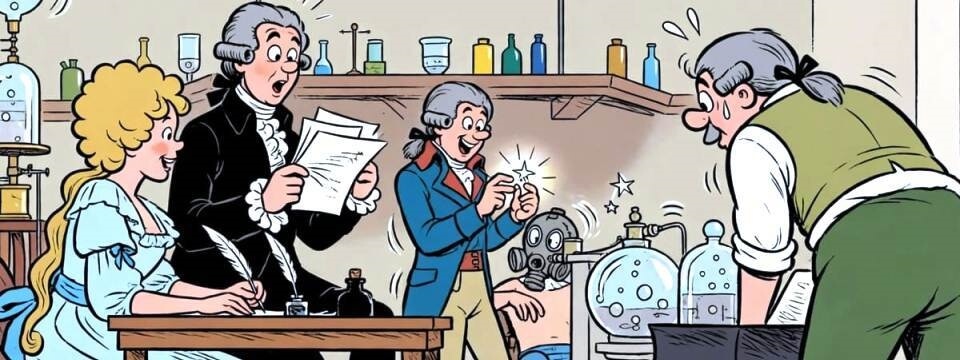
His emphasis on empirical measurement and clear terminology laid the foundation for modern chemistry. He used accurate balances to measure starting materials and reaction products, proving mass remained constant.
He also investigated air composition, respiration, and calorimetry alongside his wife and scientific collaborator, Marie-Anne Paulze Lavoisier.
Scientific Contribution of Prominence
Antoine Laurent Lavoisier is best known for disproving the phlogiston theory. Scientists thought that substances which burn contained something called phlogiston. When they burned, they released the phlogiston into the air.
Antoine Laurent Lavoisier found that metals gain weight when they burn because they combine with oxygen.
His oxygen combination theory replaced the phlogiston theory. Antoine Laurent Lavoisier showed how living organisms use oxygen in breathing and how it joins with hydrogen to form water. After his discoveries, they advanced chemistry rapidly.
What was the reason for Antoine Laurent Lavoisier’s execution?
Antoine Laurent Lavoisier was executed by guillotine during the Reign of Terror in the French Revolution primarily for his past role in a royal tax-collection company.
Authorities arrested him on November 24, 1793, for his role as an administrator in the Ferme générale. A despised private tax-collecting firm under the monarchy accused Lavoisier of tax fraud, embezzling funds, and selling adulterated tobacco.
The Revolutionary Tribunal tried Lavoisier, and they guillotined him on May 8, 1794, alongside his father-in-law and 26 or 27 other tax farmers (28 co-defendants in total).
Workers placed his body and head along with the other dead bodies and heads in a wagon or common sack and buried them in an unmarked mass grave.
Mathematician Joseph-Louis Lagrange remarked that it took only an instant to cut off his head, and a hundred years might not produce another like it. The French government officially exonerated Lavoisier a year and a half after his death.
But why did the French government exonerate Lavoisier?
The French government exonerated Antoine Lavoisier about a year and a half after his execution because the political climate changed after the fall of Maximilien Robespierre.
The radical Jacobin regime collapsed in July 1794, prompting authorities to acknowledge that they had unjustly and politically motivated his trial during the Reign of Terror.
The new, more moderate government (the Thermidorian Reaction) sought to distance itself from the excesses of the Terror and overturn many of its hasty convictions.
Officials primarily targeted Lavoisier because of his wealth and his role as an administrator in the Ferme Générale—an unpopular, private tax-collecting agency under the old monarchy.
The Revolutionary Tribunal convicted him in a single day on trumped-up charges of defrauding the state, selling adulterated tobacco, and conspiring with foreigners.
Once the political panic subsided, officials recognized there was no legitimate evidence of treason or fraud.
Many viewed Lavoisier’s execution as a massive loss to France and the scientific world, recognizing his scientific contributions as the “father of modern chemistry.”
Following persistent advocacy by his widow, Marie-Anne Paulze Lavoisier, and fellow scientists, the government officially cleared his name.
In late 1795, the French government returned Lavoisier’s confiscated personal belongings and scientific instruments to his widow, accompanying the items with a brief, formal note that read: “To the widow of Lavoisier, who was falsely convicted.”