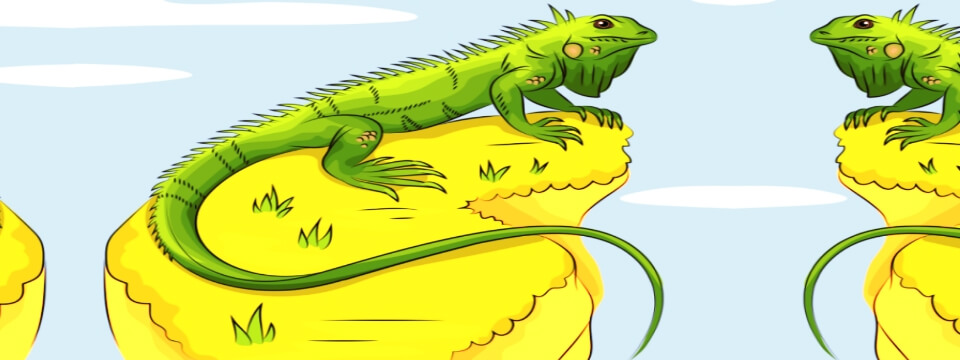
Iguana is a lizard found in the New World. Iguanas, belonging to the family Iguanidae, thrive across a wide range of habitats in the New World, from lush rainforests to arid deserts.
Among these fascinating reptiles, the basilisk of Central America stands out for its extraordinary ability to run on its hind legs, a remarkable adaptation that allows it to evade predators while navigating its environment with agility.
While some iguanas prefer to inhabit the treetops, basking in the sun and foraging for leaves, the marine iguana is unique as the only lizard known to live in or near the ocean.
This remarkable creature can dive underwater, using its powerful limbs and streamlined body to forage for seaweed along rocky shorelines and in turbulent waters.
Distinctive Physical Features
The two recognized species within the genus ‘Iguana’ showcase distinctive physical features that are integral to their survival. Each iguana sports a dewlap—a flap of skin under its throat—used in courtship and territorial displays.
Additionally, a striking row of spines runs along their backs to their tails, providing a formidable defense against potential threats.
They also possess a third “eye,” scientifically referred to as the parietal eye, which appears as a pale scale on the top of their heads. This unique structure is sensitive to light and may assist in regulating their daily activity patterns, allowing them to remain vigilant against potential dangers.
Behind their necks, iguanas have small, spiky scales known as tuberculate scales. These scales can display a variety of vibrant colors, ranging from greens and browns to more vivid hues, ensuring that iguanas can adapt visually to their surroundings.
Interestingly, these scales may not always be easily visible from close distances, blending seamlessly into their environment. In addition to the tuberculate scales, iguanas have a prominent round scale on their cheeks, known as the subtympanic shield, which plays a role in their auditory perception.
Fascinating Adaptations
Iguanas possess exceptional vision, allowing them to detect shapes, shadows, colors, and movement from considerable distances. This keen eyesight is crucial for navigating through densely vegetated areas, helping them avoid obstacles and locate food sources such as leaves, flowers, and fruits.
Furthermore, iguanas rely heavily on visual signals to communicate with one another. They often use body language, including head bobbing and displaying their dewlap, to establish dominance or attract mates, emphasizing their social interactions.
The tympanum, positioned just above the subtympanic shield and behind the eye, functions as the iguana’s eardrum, enabling them to perceive sounds in their environment.
Despite their size, iguanas can be surprisingly difficult to spot in the wild, as they have evolved to blend seamlessly into their surroundings. Their myriad scale colors and patterns serve as an effective form of camouflage, shielding them from larger predators such as birds of prey and mammals.
In addition to these fascinating adaptations, male iguanas, along with other male members of the order Squamata, possess two hemipenes, specialized reproductive organs that allow for more effective mating.
This characteristic highlights the unique evolutionary traits within the lizard family and showcases the diverse adaptations that help iguanas thrive in a variety of ecosystems.
Overall, iguanas embody a remarkable blend of physical adaptations and behaviors that contribute to their success as one of the most captivating reptiles in the animal kingdom.
Do Iguanas Drop from Trees?
Yep, dropping iguanas are real.And believe it or not, it’s all about the weather.Iguanas, like many reptiles, are cold-blooded, which means they rely on the sun and warm temps to regulate their body heat.
When the temperature drops below 50°F, their bodies literally start to shut down.Muscles freeze up, and they can’t move—so if they’re lounging in a tree (as iguanas love to do), gravity takes over.Boom, Iguana drops.
But don’t worry—they’re not dead.Most of the time, these cold-stunned iguanas just enter a temporary coma.As the sun comes back out and temperatures rise, they thaw out and come back to life—usually a little confused and maybe a bit embarrassed.
Where Do Iguana Drops Happen?
This bizarre phenomenon only occurs during rare cold snaps, usually in January or February, when nighttime temps take a dip.
You’ll see it more often in South Florida, including here in the Florida Keys, where green iguanas have made themselves right at home (even though they’re technically invasive).
Locals are used to it, but for visitors, it can be a jaw-dropping sight.Imagine walking outside your hotel and seeing five lizards napping on the ground like it’s siesta time in the jungle.