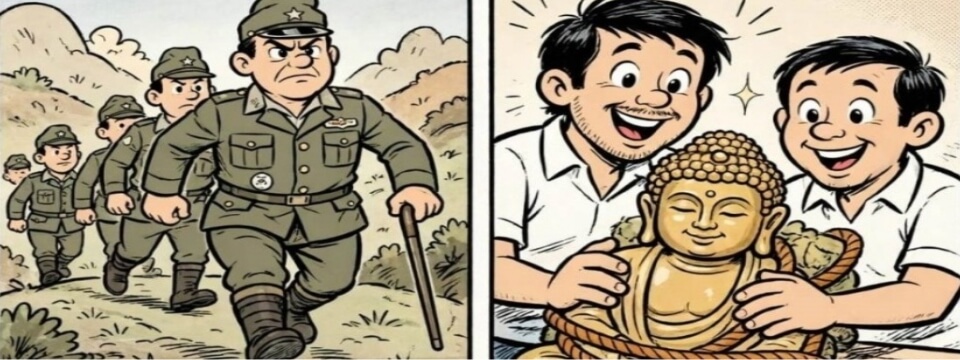
When General Tomoyuki Yamashita faced execution on February 23, 1946, did he carry an incredible secret to his grave? Did he hide fabulous treasure in the mountains?
Known as the ‘Tiger of Malaya,’ Yamashita earned this nickname after his 30,000-strong army conquered British-held Malaya, culminating in Singapore’s fall on February 15, 1942.
Against a combined British and Commonwealth force of 80,000, Yamashita’s troops delivered what Winston Churchill termed the ‘worst disaster’ in British military history.
The Japanese occupation of Malaya and Singapore was brutal, particularly for the thousands of Chinese residents. During the ‘Sook Ching massacres,’ the Kempeitai rounded up and executed thousands of Chinese individuals, with estimates suggesting 50,000 to 100,000 predominantly Chinese men perished after the invasion.
A banishment awaited Yamashita
Despite his victories, Yamashita faced banishment to Manchukuo due to rival Prime Minister Hideki Tojo. He returned to front line duty in July 1944 as the commander of the defense forces in the occupied Philippines.
By September 1944, the Allies advanced as the tide of war turned against Japan. Yamashita organized defenses in the Philippines and ordered a retreat to the Sierra Madre mountains to prevent civilian and military casualties.
However, Rear Admiral Sanji Iwabuchi disregarded his orders and retook Manila, resulting in massive destruction and approximately 100,000 Filipino civilian deaths.
Rumors of hidden treasure emerged after Yamashita’s retreat. As Japanese forces swept through Asia, they reportedly amassed vast fortunes in stolen treasure. With Japan on the defensive, Prince Tsuneyoshi Takeda decided to secure this wealth from the Allies for post-war retrieval.
The construction of tunnels in the mountains
Takeda allegedly commissioned the construction of the ‘Golden Lilly’ tunnels—a vast network in the Philippine mountains. Legend has it that Yamashita oversaw the creation of a tunnel, ‘number eight,’ in the Cagayan Valley.
When filled with treasure, the slaves who built it and the supervising soldiers were supposedly sealed inside to ensure only Yamashita and Takeda knew its location.
After Manila fell, the Allies advanced, and Japan surrendered on August 15, 1945. Yamashita’s forces held out until September 2, when he surrendered. Tried for the crimes committed by his troops, Yamashita was executed despite appeals for clemency. If treasure lay hidden in Luzon, the general took its secret to the grave.
An international attraction for treasure hunters
The tale of Yamashita’s gold spread, attracting treasure hunters worldwide to Luzon. All emerged empty-handed, but this didn’t deter future explorers. In the 1970s, a new wave of hope emerged with the story of Rogelio Roxas.
Roxas revealed that he had dragged the Buddha out of the tunnel and hidden it in his home along with a crate of gold bullion.
Rogelio Roxas and the Filipino president
Did Roxas truly discover it only to have it stolen by Ferdinand Marcos? Things took a bizarre turn when Ferdinand Marcos, the Filipino president, learned of Roxas’ discovery and sent soldiers to break into his house to seize the treasure.
Outraged, Roxas went to the press to shame the President, but instead, government troops imprisoned and tortured him to extract the tunnel’s location. He refused to reveal it and endured years in jail. After his release, Roxas stayed silent about his discovery, fearing another imprisonment.
In 1988, now the head of the Golden Buddha Corporation, he sued the exiled Ferdinand and Imelda Marcos in a Hawaiian state court for stealing the Buddha and gold, as well as for false imprisonment and human rights abuses.
Roxas died before the case went to court, but the judge ruled in his favor, ordering the Marcoses to pay the Roxas estate and the Golden Buddha Corporation $22 billion in 1996.
Marcos appealed, and the order was reversed the following year due to lack of evidence of the treasure’s existence, though he was ordered to pay $6 million for human rights abuses. Notably, neither Ferdinand nor Imelda Marcos ever paid a cent of the settlement.
So, did General Yamashita and Prince Takeda bury an enormous treasure in the Philippines? Did the Americans, as one dubious conspiracy theory suggests, uncover it to use as dark money during the Cold War? Did Marcos find the treasure and fund his and Imelda’s lavish lifestyles?
With the Lost Gold of WWII, we may finally uncover the truth about this elusive treasure.