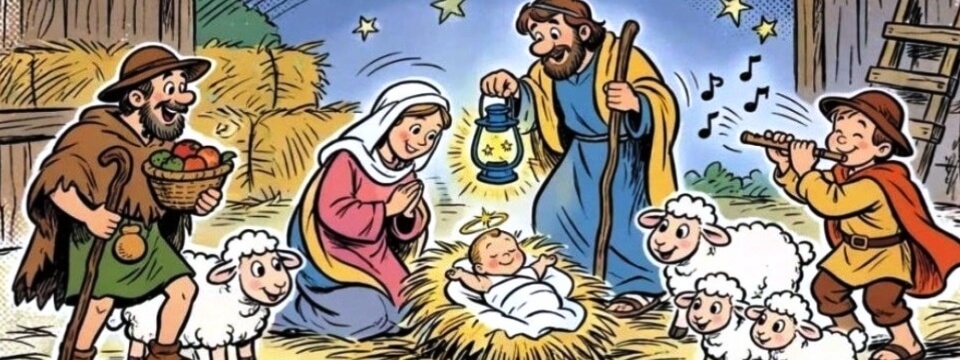
Several significant historical events took place on Christmas Day, a date primarily known for celebrating the birth of Jesus Christ.
Here are some key moments that shaped history:
800 AD: Charlemagne Crowned ‘Emperor of the Romans’
On Christmas Day 800 AD, Pope Leo III crowned Charlemagne, the Frankish king, as the ‘Emperor of the Romans.’ This act revived the imperial title roughly 300 years after the fall of the Western Roman Empire. Charlemagne, often called the “Father of Europe,” united much of Western Europe under the Carolingian Empire, fostering Christian expansion and a cultural revival.
1066 AD: William the Conqueror Crowned King of England
On December 25, 1066, William the Conqueror claimed his crown at Westminster Abbey, following his decisive victory over King Harold II at the Battle of Hastings earlier that year. This event marked the beginning of Norman rule in England, ending over 600 years of Anglo-Saxon dominance and instigating profound cultural, social, and political changes.
1642: Birth of Isaac Newton
Isaac Newton, one of history’s most influential scientists, was born on Christmas Day in 1642. His groundbreaking work laid the foundations for classical mechanics, explaining gravity and motion. In addition to his contributions to mathematics and philosophy, Newton’s insights profoundly shaped our understanding of the natural world.
1776: George Washington Crossed the Delaware River
On Christmas night in 1776, General George Washington led his troops across the ice-covered Delaware River in a bold surprise attack against Hessian forces celebrating the holiday. This daring maneuver resulted in a crucial victory for the Continental Army, boosting morale and changing the course of the American Revolutionary War.
1818: “Silent Night” First Performed
The cherished Christmas carol “Silent Night” made its debut in Oberndorf, Austria, on this day. Composed by Franz Xaver Gruber with lyrics by Joseph Mohr, the carol has since become a beloved classic, resonating with themes of peace and goodwill.
1831: The Great Jamaican Slave Revolt
The Great Jamaican Slave Revolt—also known as the Baptist War and the Christmas Rebellion—marked a bloody turning point in the history of slavery and directly contributed to its abolition.
It began deceptively quietly as enslaved workers, led by Baptist preacher Samuel Sharpe (who was himself enslaved), initiated a peaceful general strike across colonial sugar cane estates in Jamaica, demanding a working wage and more downtime.
However, the strike quickly escalated into a violent uprising involving over 60,000 enslaved people who set fields and buildings ablaze. In retaliation, colonial overlords, with help from Jamaican Maroons—descendants of freed slaves who had negotiated treaties with the British—suppressed the rebels brutally.
During this crackdown, hundreds of enslaved individuals lost their lives, and the aftermath brought even more executions. Among those hanged, Samuel Sharpe famously declared, “I would rather die upon yonder gallows than live my life in slavery.”
Though the revolt itself lasted only a short time, its impact resonated across the Atlantic in Britain. Parliamentary inquiries into the immense loss of life and property helped propel the passage of the Slavery Abolition Act of 1833. In recognition of his heroic bravery, Jamaica officially honored Samuel Sharpe as a National Hero in 1975.
1899: The Birth of Humphrey Bogart
On Christmas Day 1899, the film world welcomed Humphrey Bogart, the man the American Film Institute ranks as the greatest-ever male star of the big screen. However, his Christmas birthday became a contentious issue early in his Hollywood career.
Initially, he gained fame portraying hoodlums, thugs, and other villains, prompting Warner Bros., to worry that his festive birthday might soften his bad-guy image. To maintain his reputation, they fabricated a new birthday of January 23, which persisted in articles and biographies for years.
Eventually, Bogart broke free from typecasting and claimed his place as one of the silver screen’s most beloved heroes—cynical, world-weary, yet possessing a heart of gold—in classics like ‘The Maltese Falcon’, ‘The Big Sleep’, and ‘Casablanca’.
1914: Informal “Christmas Truce” Ceasefires and Football Matches
The informal Christmas Truce during World War I stands as one of the most famous examples of kindness, humanity, and peace—a bright beacon of hope amid bitter bloodshed and war.
The First World War unleashed a bloody and miserable experience, where modern weaponry and poor leadership created a grim scenario filled with death.
Yet on Christmas Day 1914, British, French, and German troops spontaneously chose to lay down their arms, meeting in No Man’s Land to exchange gifts, sing carols, and some even debated kicking around a football.
Though the unofficial Christmas Truce lasted only a few hours, its message of hope during dark times continues to resonate today.
1926: Hirohito Becomes Emperor of Japan
In 1926, Hirohito ascended the throne as the Emperor of Japan. His reign marked a significant period in Japanese history, as it transitioned from the traditional imperial authority into a more modern political landscape.
Hirohito’s leadership spanned notable events, including Japan’s military expansion during World War II and the subsequent post-war transformation of the nation.
1950: The Taking of the Stone of Destiny
Despite its simple appearance, the ancient Stone of Destiny, or Stone of Scone, has been integral to coronation ceremonies since the days of early Scottish kings. After Edward I took the Stone to London during his invasion of Scotland in the 13th century, four Scottish students decided in 1950 to steal it back.
In the early hours of Christmas Day, Ian Hamilton, Gavin Vernon, Kay Matherson, and Alan Stuart executed their daring heist. They drove 18 hours from Scotland, broke into Westminster Abbey, and removed the Stone from under the coronation chair—only for it to fall and break in two.
Undeterred, Ian took the smaller piece to a vehicle, where he and Kay pretended to be a courting couple to avoid drawing the attention of a passing policeman. The group also took the second piece and enlisted a Scottish stone mason to restore the artifact.
Months later, satisfied with the publicity they generated for Scottish nationalism, they left the Stone in an abbey for authorities to find. The Stone returned to Westminster Abbey and would formally return to Scotland in 1996.
As for the robbers, they avoided prosecution and gained fame as heroes in Scotland, with Gavin Vernon later remarking he “never had to buy a beer again” at his university bar.
1977: Charlie Chaplin Dies
Christmas Day has seen the passing of many influential figures, and on December 25, 1977, the world lost one of its most iconic stars—Charlie Chaplin.
With a career spanning over 75 years, the British comedic actor stands out as a pivotal figure in film history.
Chaplin soared to fame during the silent film era, gaining worldwide recognition with his 1915 masterpiece, ‘The Tramp’.
A master of physical comedy and a relentless perfectionist, he often took on multiple roles in his films—writing, directing, producing, composing, editing, and acting.
Many of his films, such as ‘City Lights’ (1931) and ‘The Great Dictator’ (1940), are celebrated as some of the greatest of all time.
Chaplin passed away peacefully in his sleep at the age of 88, marking the end of an era for one of cinema’s first global superstars.
1979: The Soviet Union Invades Afghanistan
In December 1979, Soviet troops marched into Afghanistan, initiating a brutal conflict that would last for nearly a decade.
1989: Nicolae Ceaușescu Executed
When Nicolae Ceaușescu ascended to the leadership of Communist Romania in 1965, he appeared to usher in a more liberal era by easing press restrictions and courting Western favor against Soviet policies.
However, this period of optimism quickly faded as he evolved into one of the Eastern Bloc’s most brutal dictators.
Imitating Stalin and Mao, Ceaușescu established a cult of personality and wielded the feared Securitate, his secret police, to suppress dissent.
He enforced draconian policies to increase the population, effectively banning abortion, removing contraceptives from circulation, and offering financial incentives to families for having many children.
This resulted in a massive baby boom that overwhelmed schools and created a tragic network of underfunded orphanages for children abandoned by parents unable to care for them.
Widespread food shortages and declining living standards fueled public outrage against the dictator, leading to his downfall in December 1989.
On Christmas Day, a hastily convened court tried Ceaușescu and his wife, Elena, and they faced a firing squad that same day. Their execution, broadcast on Romanian television, became one of the most dramatic moments of the Cold War.
1991: Mikhail Gorbachev Resigns, Marking the Fall of the Soviet Union
Established in 1922, the Soviet Union played a crucial role in 20th-century global politics, often bringing the world to the brink of nuclear disaster during its tense standoffs with the United States.
On Christmas Day 1991, the last president of the USSR, Mikhail Gorbachev, resigned, signaling the crumbling of the Soviet state. The very next day, officials dissolved the union, marking the transition to a new era for Russia under Boris Yeltsin’s leadership.
2008: India’s Chandrayaan-1 Lunar Mission Captures New Images of the Moon
In 2008, India’s Chandrayaan-1 mission provided unprecedented images of the Moon, expanding our understanding of Earth’s natural satellite.
2021: NASA Launches the James Webb Space Telescope
In 2021, NASA successfully launched the James Webb Space Telescope, opening new frontiers in space exploration and observation.