The cassowary reigns as the most dangerous bird in the world, with ostriches and emus also posing risks.
Although cassowaries tend to be shy and elusive in their natural rainforest habitats, they can inflict significant damage if provoked.
While attacks are rare, they have resulted in fatalities, including a notable incident in 2019 at a private bird collection in Florida.
Ranking as the third largest bird globally, after ostriches and emus, cassowaries can exceed 6 feet in height and weigh over 70 kilos. Despite their size, these birds are surprisingly stealthy, favoring the shadows of the rainforest.
Their formidable middle toe features a 5-inch claw, which they wield for self-defense. While they usually avoid confrontation, it’s wise to respect their space.
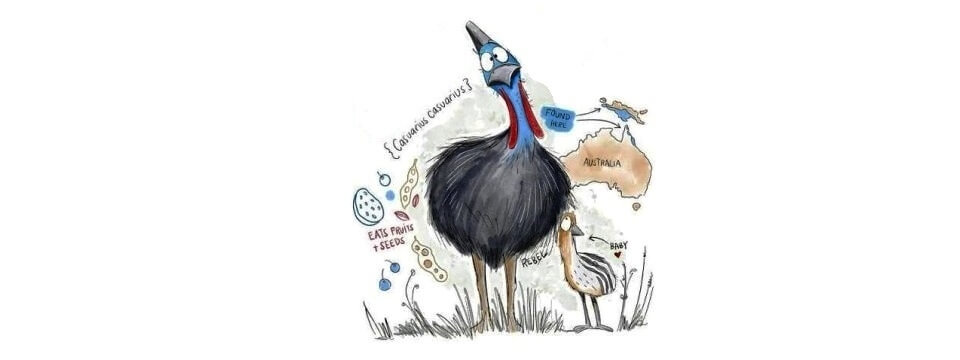
Cassowaries originate from Northern Australia, New Guinea, and nearby islands. The family Casuariidae includes three species of cassowaries, all belonging to the genus Casuarius:
- Casuarius casuarius: The southern or double-wattled cassowary, distinguished by its bright blue head and two red wattles, is the largest of the three. It typically lives in lowland rainforests and occasionally in eucalyptus forests or swampy areas.
- Casuarius unappendiculatus: Known as the northern or single-wattled cassowary, this species inhabits the coastal swamps and lowland rainforests of northern New Guinea.
- Casuarius bennetti: The dwarf cassowary is smaller, averaging around 50 pounds, and lives at higher altitudes in steeper, mountainous regions.
Cassowaries share a close evolutionary connection with dinosaurs. Their distinctive wedge-shaped casque resembles a helmet and could serve multiple purposes—protecting their heads during navigation through dense trees, asserting dominance, or even detecting vibrations from other forest creatures.
Standing up to six feet tall and weighing as much as 160 pounds, these flightless birds boast powerful legs that propel them at impressive speeds.
Cassowaries exhibit remarkable athleticism, swimming expertly, leaping over obstacles, and sprinting through the forest at speeds up to 50 km/h.
They can even jump up to 7 feet straight into the air. With their legs, they deliver powerful kicks, and their sharp claws, measuring up to 4 inches long, can inflict serious injury on threats, including humans.
Cassowaries primarily feast on fallen fruit from the rainforest floor, consuming over 150 different varieties. Occasionally, they might snack on insects, fungi, or small mammals, even catching fish by using their feathers to create a net while sitting in a stream.
Interestingly, they often swallow their food whole, relying on their digestive system to break it down, and their large seed-filled droppings play a vital role in plant regeneration.
Females lay about three eggs in a ground nest, while males incubate them for roughly 50 days, with each egg weighing as much as ten average chicken eggs.
For some Aboriginal groups, cassowaries hold cultural significance, appearing in traditional ceremonies, dances, and Dreamtime narratives. Many indigenous communities engage in conservation efforts, combining traditional ecological knowledge with modern science.
Whether you admire their striking appearance, impressive athleticism, or unique feeding habits, one thing is clear: no other creature resembles a cassowary.
Unfortunately, wild cassowary numbers are declining due to habitat destruction and cyclones. Protecting these magnificent birds is essential, not only for their sake but also for their vital role in regenerating tropical forests by dispersing seeds.