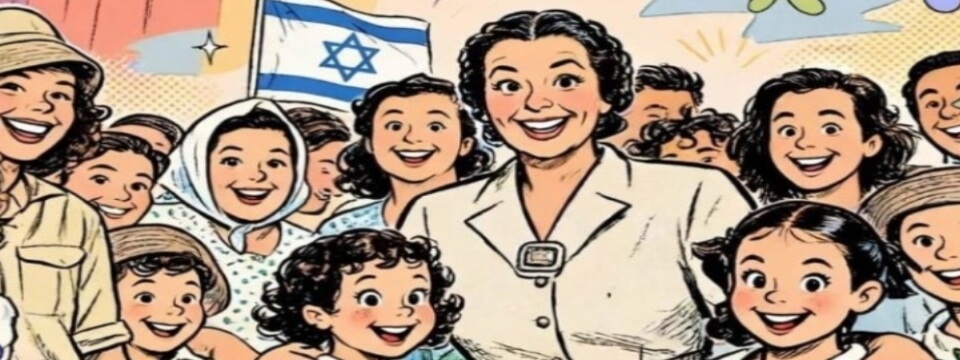
Golda Meir earned the title of Israel’s “Iron Lady” due to her strong and determined leadership style during a tumultuous period in Israeli history.
Serving as Prime Minister from 1969 to 1974, she faced significant challenges, including the Yom Kippur War in 1973. Her steadfast approach to governance, commitment to national security, and no-nonsense demeanor resonated with the public, cementing her reputation as a formidable leader.
Meir displayed her directness and refusal to shy away from tough decisions, often making controversial choices for the sake of Israel’s security and survival.
She also became one of the first female leaders of a nation in the modern era, breaking gender barriers and earning respect on the international stage. This combination of resilience, courage, and leadership in a male-dominated political landscape contributed to her enduring legacy and the nickname “Iron Lady.”
Born in Kyiv on 3rd May 1898, Golda Meir was one of Moshe and Blume Mabovitch’s eight children. They couldn’t have known it at the time, but their daughter would become one of the most influential female political figures of the 20th century.
These six facts about Golda Meir can tell you a lot about the woman from her beginnings in the Russian Empire to her global impact on politics.
What is Golda Meir most famous for?
Golda Meir was a politician who helped to found the state of Israel in 1948 and served as the fourth Israeli Prime Minister between 1969 and 1974. The first female head of government, Golda has remained the only female head of government in the Middle East to date. She led Israel through the instability of the Yom Kippur War. Also known as the Ramadan War and the October War, the conflict ran from 6th to 25th October 1973 and involved Israel and a coalition of Arab states.
Where did she come from?
Golda Meir was born in downtown Kyiv. Now part of modern-day Ukraine, Kyiv remained a part of the Russian Empire in 1898. After her father moved to America for work, Golda and her family crossed the Atlantic to join him, settling in Milwaukee.
As a teen, Golda clashed with her parents who wanted her to marry young and settle down with a family. Instead, Golda ran away to live with her married older sister, Sheyna, to focus on a higher education.
In 1913, while living with her sister in Denver, Colorado, Golda attended talks on progressive subjects like women’s suffrage, Zionism, and trade unionism. She attributed these talks to shaping her strong and fiery convictions later in life.
What was Golda Meir’s marital status?
Golda met her husband, Morris, while living with her sister. He was one of the Zionists who gathered at her sister’s home, and the two quickly fell in love. Returning to Milwaukee, Golda trained as a teacher; however, she never got to work in a school as, in 1921, Golda and Morris moved to the Land of Israel. It was here that her political career took off.
In what year did Golda Meir sign the Declaration of Independence?
Golda was one of two women to sign Israel’s Declaration of Independence. She didn’t just help found the State of Israel; she also helped to populate it. Between 1949 and 1951, Golda used her position as Israel’s Minister of Labour to welcome Jewish refugees from across the world into Israel. The population doubled from 800,000 to 1,600,000.
How did Golda Meir participate in Yom Kippur War?
As well as helping to found the state of Israel in 1948, Golda Meir served as Israel’s first and only female Prime Minister, who led Israel through the political instability of the Yom Kippur War.
Also known as the Ramadan War and the October War, the conflict ran from 6th to 25th October 1973 and involved Israel and a coalition of Arab states.
Meir’s political leadership throughout the conflict polarized public opinion, with many vocal critics blaming her for the outbreak of war. The political infighting within her government led Golda to resign as Prime Minister in April 1974.
Golda Meir: what happened to her?
Golda remained in power until June 1974, when a new government formed. Despite no longer holding a seat of power, Golda stayed involved in politics until she died of Lymphoma just four years later in 1978.
Golda Meir’s five most famous quotes…
- ‘Not being beautiful was the true blessing. Not being beautiful forced me to develop my inner resources. The pretty girl has a handicap to overcome.’
- ‘I can honestly say that I was never affected by the question of the success of an undertaking. If I felt it was the right thing to do, I was for it regardless of the possible outcome.’
- ‘Don’t be so humble – you are not that great.’
- ‘Trust yourself. Create the kind of self that you will be happy to live with all your life.’
- ‘One cannot and must not try to erase the past merely because it does not fit the present.’