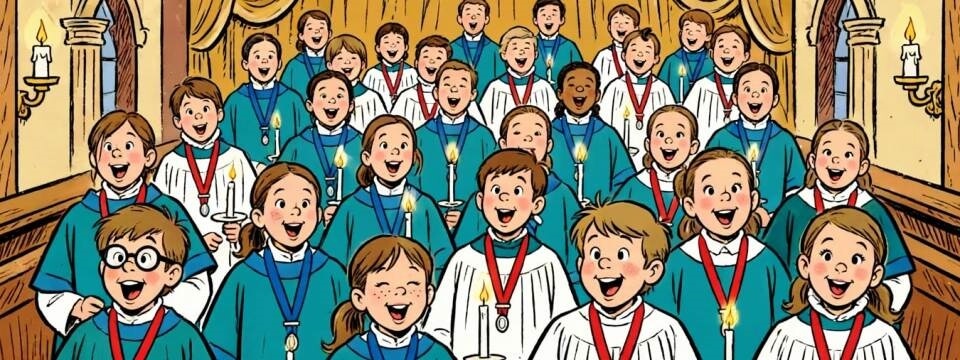
During the Middle Ages, people began singing Christmas carols using common songs as tunes for celebrations of the winter solstice before they became Christian hymns and modern holiday classics.
Originally, people performed the word “carol” as a happy dance or song all year, not just around Christmas. The term comes from old dance-song traditions like the French carole.
Many people include singing carols as much a part of their Christmas celebrations as eating mince pies and drinking mulled wine. Few people recognize the intriguing background behind the customary festive melodies that blast out across the nation each year.
Come with us as we discover the origins, context and provenance of some of our favourite Christmas carols.
Silent Night
Silent Night is one of the most enduringly popular Christmas carols, which translators have rendered into over 300 languages, and UNESCO has designated it as a treasured item of Intangible Cultural Heritage.
A young priest called Joseph Mohr penned a poem in German called Stille Nacht in 1816 in a small Alpine town in Austria. Mohr wished to raise the hopes of his congregation with his poetry while writing in the aftermath of the Napoleonic Wars and the recent eruption of Indonesia’s Mount Tambora, which had caused crops to fail across Europe.
In 1817, he teamed up with a friend and local organist, Franz Xaver Gruber, to convert his poem into a song. On Christmas eve, 1818, Mohr’s congregation performed Silent Night for the very first time.
Nearby valleys welcomed the song as travelling families of folk singers took it across Europe and eventually to America.
During the First World War, both German and British soldiers poignantly sang the song during the famous Christmas Day Truce of 1914. Its enduring message of peace, even amongst great suffering, has transcended cultures and generations.
Away in a Manger
Away in a Manger has murky origins. Several American magazines first published it in the 1880s. An anonymous donor sent it to them, claiming that the 16th-century German religious reformer, Martin Luther, penned it.
Experts on Luther, however, dispute this claim, leading us to believe that an unknown American will forever remain the writer of this Christmas classic. What we do know is that during the 1890s, the song swept across the United States.
In 1895, American composer William J. Kirkpatrick adapted the song and composed the melody that we know today. As part of a collection called ‘Around the World with Christmas’, Kirkpatrick’s take on Away in a Manger later appeared in several hymn books, carrying the song beyond the confines of America and onto the rest of the world.
O Come All Ye Faithful
One of the oldest carols still popular today has one of the most fascinating backstories – O Come All Ye Faithful.
Originally, someone wrote it in Latin as Adeste Fideles, and the text could date back as far as the mid-1600s. As for its author, experts have suggested myriad candidates from King John IV of Portugal (a 17th-century amateur composer) to Cistercian monks.
What we do know is that John Francis Wade, an English Catholic exile living in France, compiled the earliest printed version of the lyrics during the mid-1700s.
Fascinatingly, some historians believe Wade’s version contains a secret hidden message. After fleeing to France following the Jacobite rising of 1745, historians argue that Wade hid subversive messages within the song to rally support for the exiled Bonnie Prince Charlie.
As for the tune, again no one knows for sure who composed it. A variety of names have entered the discussion, including German composers Handel and Gluck.
As for its lasting legacy, O Come All Ye Faithful remains a carol service favorite due to its upbeat and jolly melody, and people often leave it until last on the hymn sheet to ensure all finish with festive feelings of happiness and joy.
We Three Kings
We have to venture back across the Atlantic to uncover the origins of We Three Kings. John Henry Hopkins Jr, an American clergyman and hymn writer, wrote and composed it in 1857 for a New York Christmas pageant, making We Three Kings the first widely popular Christmas carol originating from the States.
Hopkins based the lyrics on the narrative of the journey of the Magi as they made their way to see the newborn baby Jesus, as mentioned in Mathew 2:1-12.
Rather unusually for many carols, Hopkins composed both the lyrics and the music. Due to the positivity around its reception, Hopkins decided to publish the carol in 1863 in his book Carols, Hymns, and Songs. Its popularity soon spread as it found its way into hymn sheets across the world.
Good King Wenceslas
This popular carol has one of the most strange, gruesome and un-Christmassy backstories. It’s based on the life of Wenceslaus I, Duke of Bohemia, who lived during the early 900s AD.
Legend states that his younger brother, Boleslaus the Cruel, assassinated him. After Wenceslaus’ death, sainthood beckoned and this popular martyr soon inspired people to venerate his good deeds, especially in Bohemia and England.
‘I think you know his deeds better than I could tell you; for, as is read in his Passion, no one doubts that he rose every night from his noble bed, with bare feet and only one chamberlain, went around to God’s churches and gave alms generously to widows, orphans, those in prison and afflicted by every difficulty,’ wrote one 12th century preacher.
This legend became the foundation of the carol that John Mason Neale, an English priest and hymn writer, penned in 1853. The words set to a 13th-century melody called ‘Tempus adest floridum’, a tune about Eastertime.
Neale wrote it for the Feast of St. Stephen (i.e. Boxing Day), and its words also celebrate the long tradition of charitable giving on the Second Day of Christmas. Wenceslas’s body now lies in St Vitus’s Cathedral in Prague. His Saint’s Day also serves as a public holiday in the Czech Republic.