John Fitzgerald Kennedy: A Dynamic Legacy
John Fitzgerald Kennedy (1917-1963) stood as a pivotal American statesman and the 35th President of the United States from 1961 to 1963. Born in Brookline, Massachusetts, he emerged from a prominent family; his father, Joseph Kennedy, was a well-known businessman and diplomat.
During his presidency, JFK pressed the USSR to withdraw its missiles from Cuba in 1962 and later negotiated a Nuclear Test Ban Treaty with Soviet leader Nikita Khrushchev, easing tensions between the two superpowers.
Nonetheless, he also escalated U.S. involvement in Vietnam. Tragically, he was assassinated in Dallas, Texas, on November 22, 1963.
Early Life and Education
Kennedy, the second of nine children, grew up in a household where competition fueled ambition. The family’s legendary touch football games at their Hyannis Port retreat were just one facet of an upbringing steeped in the teachings of the Roman Catholic Church and the values of the Democratic Party.
His father amassed a fortune through various ventures, including banking and the film industry, ensuring financial security for his children with trust funds.
After his father’s term as U.S. ambassador to Great Britain, John served as his secretary, using the experience to write a senior thesis at Harvard University.
He expanded this work into the bestselling book ‘Why England Slept’ (1940). In 1941, Kennedy enlisted in the U.S. Navy, commanding a patrol torpedo boat in the South Pacific.
He demonstrated exceptional bravery, leading his crew to safety after a Japanese destroyer sank their boat, earning the U.S. Navy and Marine Corps Medal for heroism.
Political Rise: Congressman and Senator
Kennedy entered politics with confidence, winning a congressional seat in 1946 at just 29. Ignoring the Democratic establishment, he relied on family, friends, and fellow Navy officers, ultimately overwhelming his opponent.
His ambition propelled him to the U.S. Senate in 1952, where he campaigned effectively against the popular incumbent, Henry Cabot Lodge. His marriage to Jacqueline Lee Bouvier in 1953 further enhanced his public image.
In the Senate, Kennedy championed civil rights and foreign aid for emerging nations. His increasing prominence set the stage for his presidential ambitions.
Presidential Campaign and Achievements
In January 1960, Kennedy declared his candidacy for president, facing strong competitors like Hubert H. Humphrey and Lyndon B. Johnson.
He tackled concerns about his Catholic faith, winning the primary in predominantly Protestant West Virginia and affirming the separation of church and state in a televised address. His successful campaign culminated in a narrow victory against Richard Nixon.
National Inspiration from the President
As president, he inspired the nation with his famous inaugural address, urging Americans to consider what they could do for their country. However, his administration faced immediate challenges, including the disastrous Bay of Pigs invasion in 1961, for which he accepted full responsibility.
At a pivotal summit in Vienna, Kennedy confronted Khrushchev successfully, prompting him to back down from aggressive posturing in Berlin.
Following the Cuban missile crisis in 1962, where he demanded the dismantling of Soviet missiles in Cuba, Kennedy achieved a significant diplomatic victory with the signing of the Nuclear Test-Ban Treaty.
The Assassination
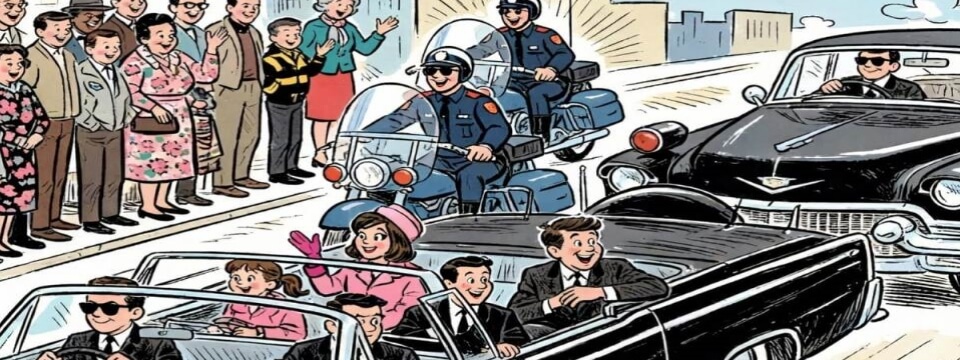
On Friday, November 22, 1963, President John F. Kennedy and Jacqueline Kennedy rode in an open limousine during a motorcade through downtown Dallas. At 12:30 PM, an assassin struck him with two rifle bullets—one at the neck and another in the head.
Medical staff pronounced him dead shortly after arrival at Parkland Memorial Hospital. Although gravely wounded, Governor Connally recovered.
Vice President Johnson then took the oath of office, while a 24-year-old Dallas citizen, Lee Harvey Oswald, faced accusations of the assassination. Two days later, Jack Ruby shot Oswald dead in a Dallas police station basement.
Presidential Campaigns
Though John Kennedy had died, the Kennedy mystique thrived. Robert and Ted both pursued presidential campaigns (in 1968 and 1980, respectively). Unfortunately, tragedy became nearly synonymous with the Kennedy’s when Bobby suffered assassination on the campaign trail in 1968.
Jacqueline Kennedy and her children relocated from the White House to a Georgetown home. Continuous crowds made peace impossible, so she moved to New York City in the summer of 1964.
Pursuit continued until October 20, 1968, when she married Aristotle Onassis, a wealthy Greek shipping magnate. The Associated Press noted that this marriage “broke the spell of almost complete adulation of a woman who had become virtually a legend in her own time.”
Widowed by Onassis, the former first lady returned to public life in the mid-1970s as a prominent book editor, remaining one of the most admired women in the U.S. until her death in 1994.
Her daughter Caroline prioritized her privacy, while John Jr.—a lawyer like his sister and charming like his father—embraced the public spotlight.
Long remembered as “John-John,” the three-year-old who saluted his father’s casket on live television, John Jr. founded and edited the political magazine ‘George’ in the mid-1990s.
Tragically, in 1999, he, his wife, and his sister-in-law died in a plane crash he piloted, an event that captured international media attention and solidified the Kennedy mystique. This marked yet another chapter in the family’s ongoing “curse” of tragedy.
Conclusion
JFK’s presidency, though tragically cut short, left an enduring impact on American politics and foreign relations. His call to action continues to resonate, reminding us of the responsibilities of leadership in times of crisis.
Five Little Known Facts About the Life of JFK
John F. Kennedy’s presidency unfolded dramatically, filled with glamour and tragedy, culminating in assassination on November 22, 1963. To commemorate the 60th anniversary of this earth-shaking event, here are some lesser-known facts about the 35th president.
-
His Brother Was ‘Supposed’ to Be President
It’s hard to believe, but JFK originally played second fiddle to his older brother Joe Jr., whom their father, Joseph Kennedy Sr., groomed for a political career. Joseph envisioned his son as a future president and expected him to lay the groundwork at the 1940 Democratic National Convention. However, after Joe Jr. died in a wartime accident, JFK became the anointed successor, expected to fulfill his brother’s destiny. He later described it as “like being drafted.”
-
He Was Almost Constantly Ill
When JFK became president, the world admired his youthful vitality. However, he battled severe health issues throughout his life. Nearly dying from scarlet fever as an infant, he faced numerous illnesses, including debilitating back pain. Forced to take heavy medications and wear a stiff back brace, some experts believe the brace hampered his reaction during the assassination attempt in Dallas.
-
He Kept a Coconut Paperweight on His Desk
A distinctive feature of the Oval Office was a paperweight made from preserved coconut shell, a cherished artifact that represented a remarkable episode in JFK’s life. In 1943, while commanding a torpedo boat in the South Pacific, his vessel was cut in half by a Japanese destroyer. Refusing to give up, he led the crew to safety, eventually using a piece of coconut shell to send a message that led to their rescue. This incredible story made JFK a war hero and inspired the film ‘PT 109’.
-
He Was the Youngest Elected President (But Not the Youngest Ever)
Many mistakenly believe that JFK, who became president at 43, is the youngest person to assume the office. In fact, he is the youngest elected president, while Theodore Roosevelt remains the youngest ever, having taken office at 42.
-
There Was a Previous Assassination Attempt
Before his tragic assassination, Richard Paul Pavlick attempted to kill JFK while he was still president-elect. Pavlick plotted to bomb his limo but aborted the plan upon seeing JFK’s wife and kids. Authorities later ruled him mentally ill, committing him to psychiatric care. JFK reportedly felt “bemused” by the audacity of the plot.